Research at the Harvard Biorobotics Lab 2018/2019:
Data processing, Model training, Statistical Evaluation
1) Cardiac Ultrasound Cone Segmentation:
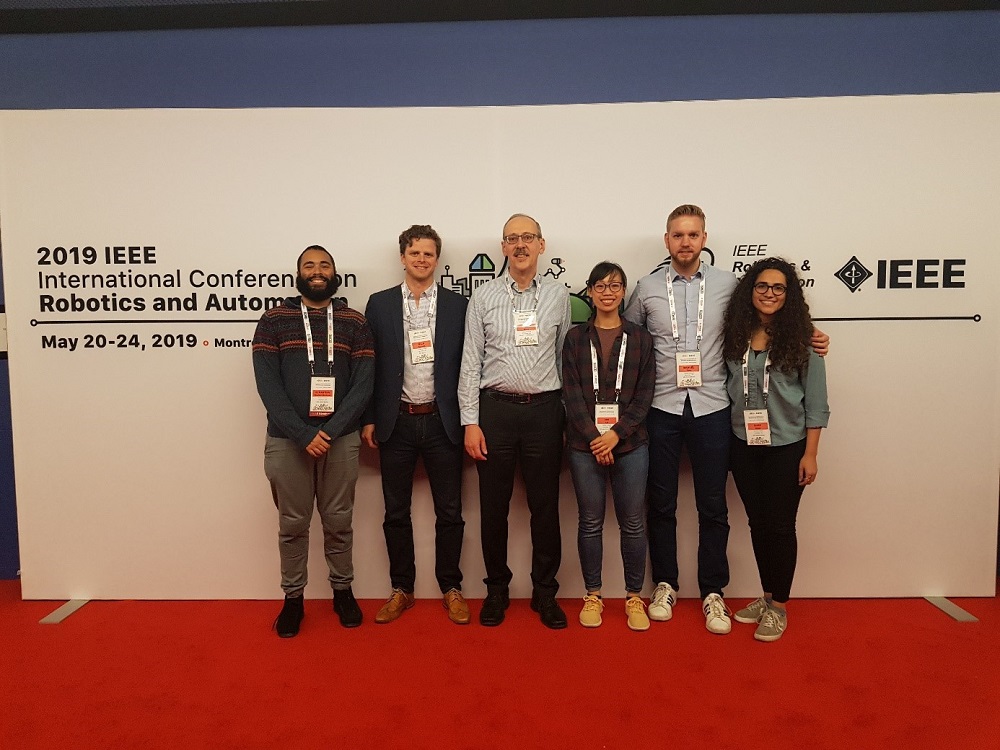 The Harvard Biorobotics Lab at the 2019 ICRA Conference
This project was in collaboration with the Boston Children's Hospital during my time as a researcher at the Harvard Biorobotics Lab. For many deep learning tasks data preprocessing is an important step to achieve better classification and detection results. Especially in applying deep learning technology for medical applications the reduction of systemic bias is a key focus to ensure patient safety. A common source for medical data are cardiac ultrasound images. Often there is still additional information visible in the image, including static and dynamic elements like saturation bars, patient data or moving EKG lines. Those additional components can create a bias for deep learning algorithms to detect or classify the given image not based on the actual ultrasound data but the additional data. Therefore this project was aimed to create a image segmentation to create a binary mask in order to remove all non-ultrasound parts of the image. The segmented images were then used to create a classification to identify different structural cardiac diseases for children.
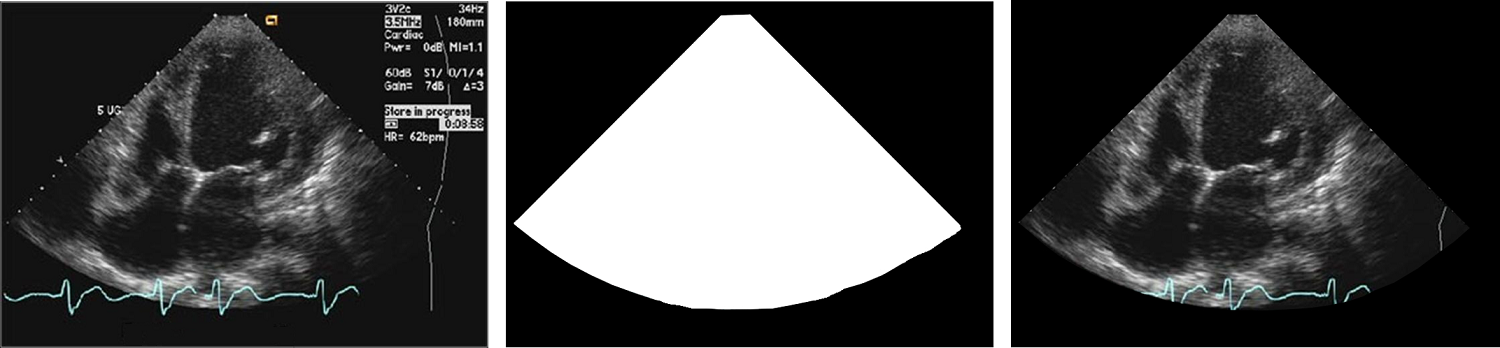 A sample input image with additional information, the automatically created binary mask and the resulting output image
2) Reducing the need for hand labeled data for deep learning models:
During the process of creating an ultrasound cone segmentation a new method to avoid large numbers of hand segmentation data was created. This allows to pretrain the existing model on less costly automatically created data and then improve the model on a small set of hand segmented data. The new method could be used for many deep learning applications since it drastically reduces the amount of labeled data that is necessary to train deep learning models.
Download Paper: Efficient human-in-loop deep learning model training with iterative refinement and statistical result validation
Some of my other technology projects:
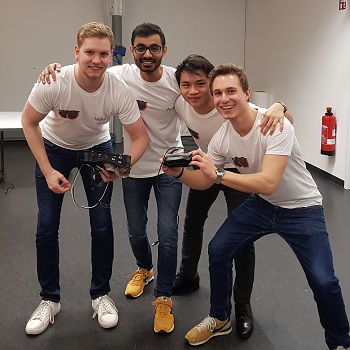
During my studies at the CDTM I was working on a technology consulting project to develp a prototype of 3D-enabled glasses and an haptic feedback wristband for enhanced navigation of blind people.
Learn More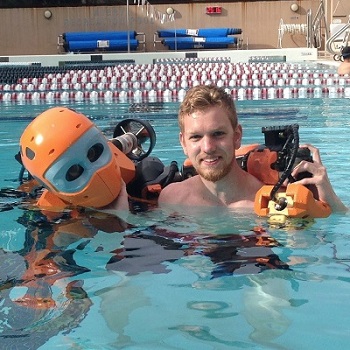
I was a resarcher at the Robotics Lab of the Stanford University in California, working in the field of underwater Robotics. I developed an underwater hand gesture recognition for diver-robot interaction.
Learn More
In addition to my research I also worked on innovation projects including startups in the field of audio technology, healthcare and retail, winning multiple awards.
Learn More